

About Baobáxia
on the Baobás Route
The idea is born from the Baobab, an African tree that lives for thousands of years and symbolically represents a territory's collective memory. Baobáxia is the union of the baobabs with the galaxies. Galaxies of memories of community territories, on the Baobás Route, on the Path of the Stars.
What Baobáxia is
Baobáxia is a free mocambola technology: free software, licensed under GPLv3, built by NPDD (the Digital Research and Development Unit) of Rede Mocambos, with leading participation from Casa de Cultura Tainã and Mercado Sul.
It's a distributed community archive. Each community keeps its own saberes (photos, videos, articles, events, collections) its own way, forming a community digital territory. The name comes from the mucua, the baobab's fruit that carries the seeds: each Baobáxia installation is a mucua, a living node that keeps and sows knowledge across the network.
Who makes it
Baobáxia comes from collective work, woven between communities and organizations that had already been walking together for a long time:

NPDD (Digital Research and Development Unit)
The Rede Mocambos unit responsible for developing Baobáxia.
Rede Mocambos
The network of quilombola, indigenous, and traditional communities that gives rise to and sustains this project.

Casa de Cultura Tainã
An urban quilombo in Campinas, São Paulo state, founding nucleus of Rede Mocambos.
Ocupação Cultural Mercado Sul Vive
The Beco da Cultura de Portas Abertas (Open-Door Culture Alley), in Taguatinga, Federal District.
How it works
Each community installs its own mucua, usually a simple computer dedicated just to that, right in its own territory, forming a community digital territory. It keeps whatever it wants there: directly online, only on the community's local network, through Tor (for those who can't expose a public address), or even by carrying a USB drive from place to place.
The structure inside follows this order, from broadest to most specific:
Syncing between mucuas uses git-annex under the hood, a system that handles large files and unstable connections well, and lets each mucua choose what to actually download (or just keep a reference, without spending space on a local copy). The diagram below shows how the pieces connect:
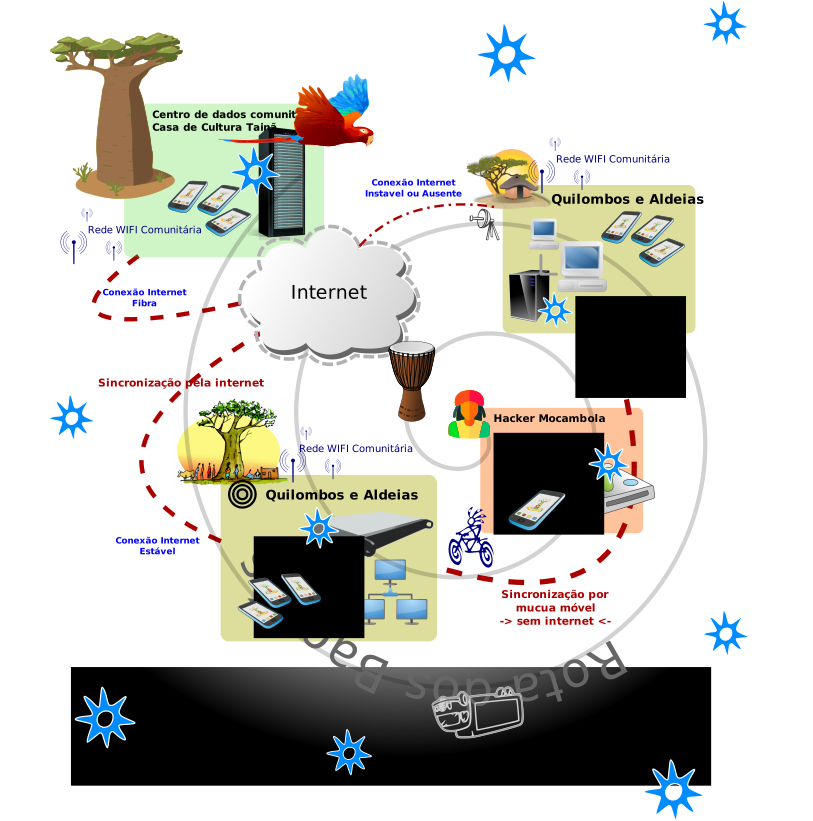
An overview of how galaxies, territories, mucuas, and the syncing between them fit together.
Baobáxia, on the Baobás Route. Free software, made by and for communities.